FTA Decision No. 13 of 2026: supplier verification before input-tax deduction
Last updated: 19 October 2026. Official sources checked: 15 October 2026.
Arabic name: قرار الهيئة الاتحادية للضرائب رقم (13) لسنة 2026 بشأن التدابير والإجراءات والاشتراطات التي يجب على الخاضعين للضريبة اتخاذها للتحقق من صحة وسلامة التوريدات قبل خصم ضريبة المدخلات
In brief
- From 1 October 2026, a UAE Taxable Person must verify the supplier and each supply before deducting input tax (FTA Decision No. 13 of 2026, Articles 2 and 7).
- The supplier checks cover identity, an actual place of business and three risk indicators. Where supplies from that supplier exceed AED 375,000 over 12 months, add a bank-account confirmation, a review of clients' recommendations where available, and a review of public reviews and media (Article 3).
- Every supply is assessed for its commercial reason, payment terms and method, pricing, licence scope, goods origin and any intermediary role (Article 4).
- Supplier checks are repeated on recurrent dealings once the supplier has not been verified for 12 months. Steps must be documented and backed by a written policy (Article 5).
- Supplies under AED 10,000 (excluding VAT) may be excluded, unless supplies from that supplier exceed AED 100,000 over 12 months (Article 6).
The question this guide answers
What must a UAE VAT-registered business check, and keep on file, before it deducts input tax on a supply it has received, under FTA Decision No. 13 of 2026?
This page summarises the Decision's text, article by article. It is general information, not legal or tax advice. The English text on tax.gov.ae is labelled "This is not an official translation". For interpretation, rely on the Arabic text and a qualified tax adviser.
What the Decision requires before an input tax deduction in the UAE
Decision 13 turns one question into a routine: is this supplier real, and is this supply genuine? It sets out:
- Supplier measures (Article 3): identity; address and place of business; risk level; and, above a value threshold, bank-account, client-recommendation and public-reputation checks.
- Supply measures (Article 4): a general assessment of the transaction, its payment conditions and its circumstances.
- Procedures (Article 5): when to run the supplier checks, checking each supply, what to document, and a policy naming who is responsible.
- Exceptions (Article 6): a low-value carve-out, with a cap.
The Decision does not ask for a supplier to be "approved" in any particular system. It asks the buyer to verify, document and be able to show the work. A completed checklist supports the decision; a person still makes it.
The legal basis: VAT Law Article 54(bis)
The Decision is issued "for the purposes of applying the provisions of Article 54(bis) of the VAT Law" (Article 2). Article 54(bis) was added by Federal Decree-Law No. 16 of 2025, which came into force on 1 January 2026 (MoF, 3 Dec 2025). Under Article 54(bis), as published in the consolidated VAT Law on tax.gov.ae:
- the FTA shall reject an input-tax deduction if the supply was part of a supply chain related to tax evasion and the Taxable Person was aware of this;
- the FTA may reject it if the Taxable Person should have been aware, based on the circumstances;
- a Taxable Person is treated as having been required to be aware if it did not verify the validity and integrity of the supplies under the measures the FTA sets. Decision 13 sets those measures.
Key dates
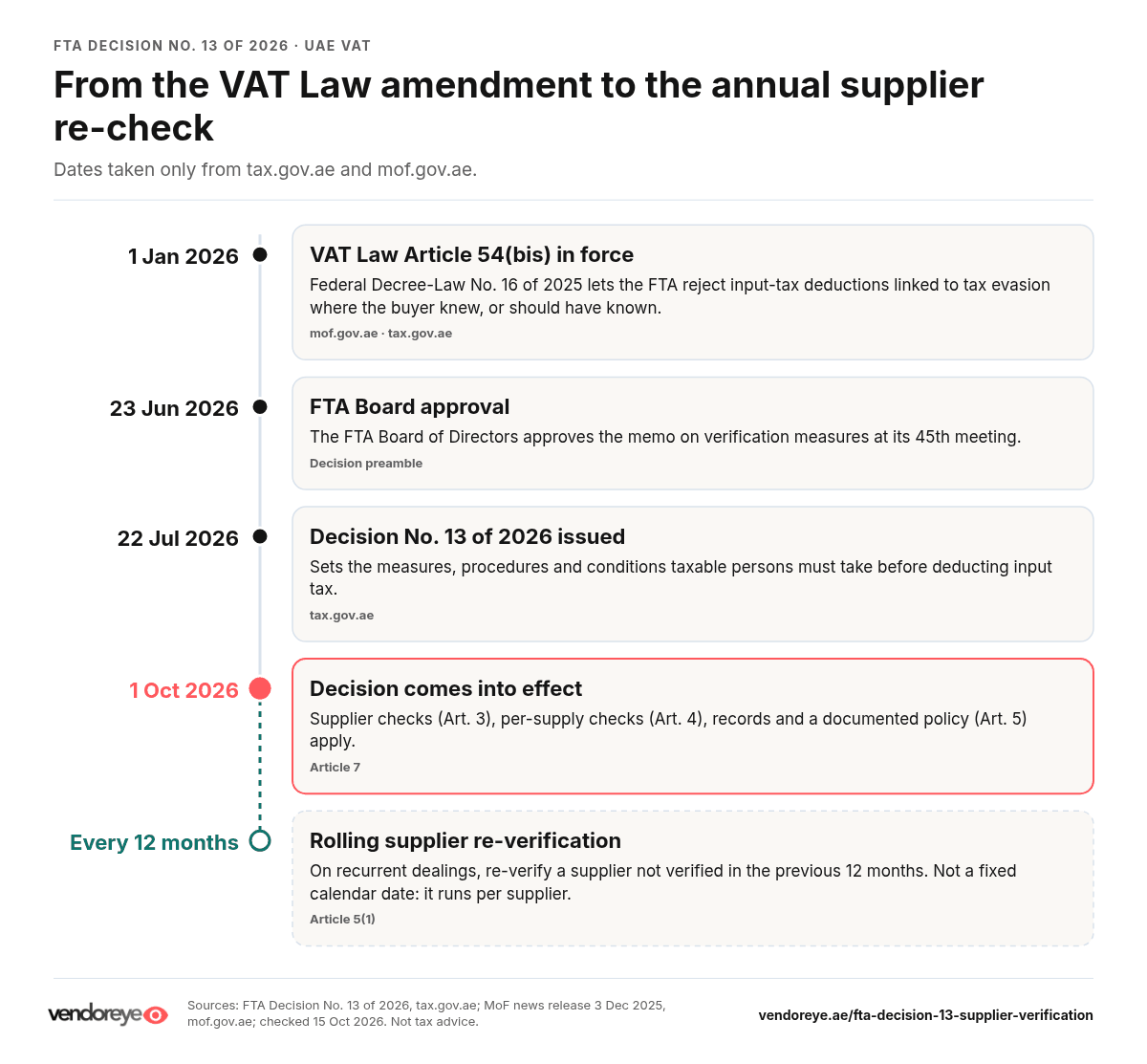
| Date | Event | Source |
|---|---|---|
| 1 Jan 2026 | Federal Decree-Law No. 16 of 2025 in force; Article 54(bis) added to the VAT Law | mof.gov.ae news, 3 Dec 2025; consolidated VAT Law, tax.gov.ae |
| 23 Jun 2026 | FTA Board of Directors approves the memo on verification measures (45th meeting) | Decision 13 preamble, tax.gov.ae |
| 22 Jul 2026 | FTA Decision No. 13 of 2026 issued | Decision 13 heading, tax.gov.ae |
| 1 Oct 2026 | Decision comes into effect | Decision 13, Article 7 |
| Rolling | Supplier re-verified on recurrent dealings once not verified for 12 months | Decision 13, Article 5(1) |
Who it applies to
The Decision applies to Taxable Persons: any person registered, or obliged to register, for tax under the VAT Law (Article 1). It covers the supplies they receive, before they deduct input tax (Article 2). Suppliers are not the addressee. The duty sits with the buyer that claims the input tax, although suppliers to VAT-registered UAE businesses should expect to be asked for this evidence.
The Decision does not separately address imports or reverse-charge supplies. "Input Tax" is defined to include tax on imports (Article 1), while Article 2 refers to "supplies they receive". If these flows matter to you, take advice from a qualified tax adviser.
The small-supply exception (Article 6)
- You may disregard the measures for a taxable supply where the consideration, excluding VAT, is less than AED 10,000 (Article 6(1)).
- The exception does not apply where the total value of supplies from that supplier exceeds AED 100,000 over the previous 12 months, or is expected to exceed it over the next 12 months (Article 6(2)).
- The Decision states "exclusive of Value Added Tax" only for the AED 10,000 test. It does not specify whether the AED 100,000 and AED 375,000 totals include or exclude VAT. Agree a basis with your tax adviser and apply it consistently.
Record why the exception applied, so a later reviewer can see it.
Does this apply to me?
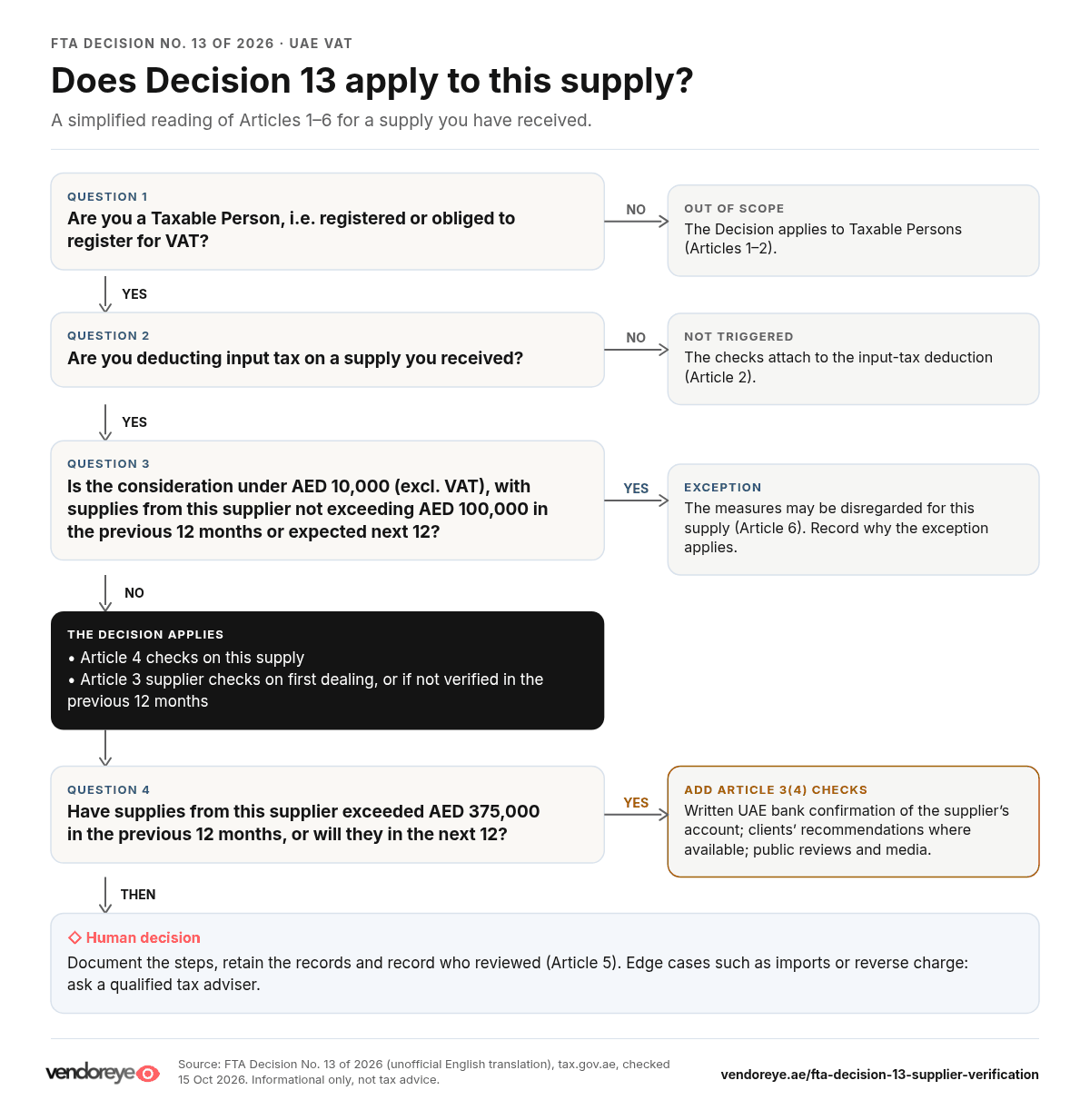
- Are you a Taxable Person (registered, or obliged to register, for VAT)? If not, the Decision does not apply.
- Are you deducting input tax on a supply you received? If not, the checks are not triggered.
- Is the consideration under AED 10,000 (excluding VAT), and have supplies from this supplier stayed at or under AED 100,000 over the previous 12 months, with no expectation of exceeding that over the next 12? If yes, the exception is available.
- Otherwise, run the Article 4 checks on the supply. Run the Article 3 supplier checks on first dealing, or if the supplier has not been verified for 12 months.
- Have supplies from this supplier exceeded, or are they expected to exceed, AED 375,000 over 12 months? If yes, add the Article 3(4) checks.
The five verification controls
The Decision does not number "five controls". This grouping of Articles 3-5 is Vendoreye's, and our 90-day implementation plan uses it too. It follows the order in which most teams meet the checks, from supplier onboarding to the input-tax claim.
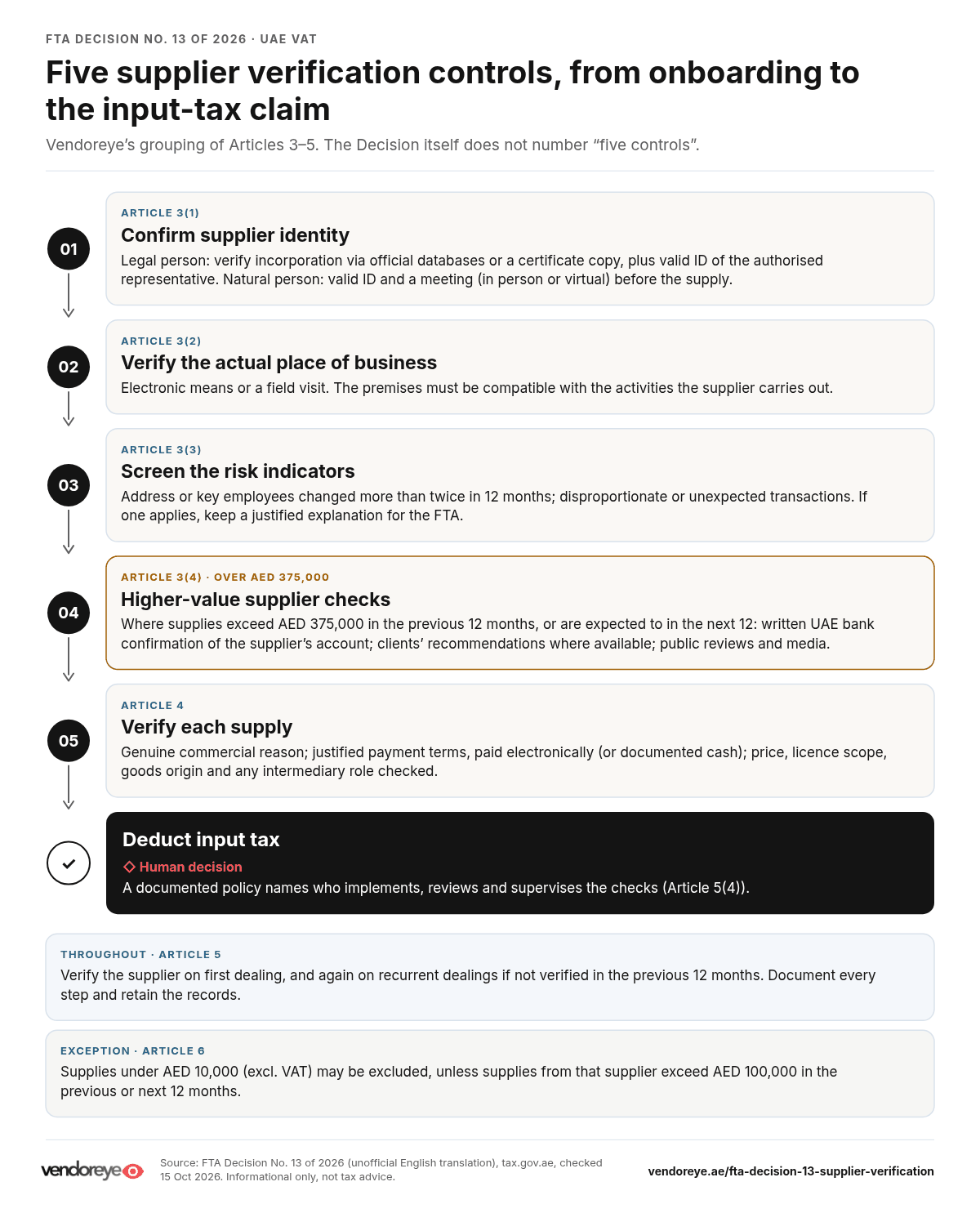
01 Confirm supplier identity (Article 3(1))
- Legal person: verify incorporation through official databases, or obtain a copy of the certificate of incorporation. The details must be valid and identical to the entity's name, address, employees and other related information. Also obtain valid proof of identity, such as an Emirates ID or passport, for the director, agent or employee authorised to represent the supplier.
- Natural person: obtain valid proof of identity, such as an Emirates ID or passport, and meet the supplier in person or virtually before the supply.
You leave with: an identity record tied to one legal entity, with its source and date. Our trade licence checks can supply part of that record. ◇ Human decision: a reviewer confirms the match.
02 Verify the actual place of business (Article 3(2))
- Confirm that the supplier has an actual place of business, "using appropriate electronic means or through conducting a field visit".
- Confirm that the place of business is compatible with the nature of the supplier's activities.
The Decision does not list which electronic means count as appropriate. Record what you used and why. Ejari-backed address verification is one option for Dubai premises. Whether it is enough on its own is a judgement for your reviewer.
03 Screen the risk indicators (Article 3(3))
Check that none of these applies:
- the supplier has changed its address more than twice over the previous 12 months;
- the supplier has changed its key employees (its managers, or the people you deal with) more than twice over the previous 12 months;
- the supplier has made transactions that are disproportionate or unexpected in volume, value or nature, compared with the size and history of its business.
If an indicator applies, the Decision does not say that this alone bars the deduction. You must keep a clear and justified explanation, give it to the FTA on request, and make sure it does not contradict the evidence or information you hold (Article 3(3)(b)).
04 Higher-value supplier checks: over AED 375,000 (Article 3(4))
These apply where supplies received from the supplier exceed AED 375,000 over the previous 12 months, or are expected to exceed AED 375,000 over the next 12 months:
- obtain a written confirmation from an authorised bank in the UAE that the supplier has a bank account, without relevant reservations or conditions. The confirmation does not have to be issued to you;
- review the clients' recommendations, where available (Article 3(4));
- review and assess publicly available reviews and media coverage from reliable sources. Check that they are consistent with the nature and size of the supplier's business, and that there are no indicators of suspected tax evasion.
Related checks: bank account (IBAN) verification and adverse media screening. An IBAN check is not the same document as the bank's written confirmation, so keep the two separate on file.
05 Verify each supply (Article 4)
For every taxable supply received or accepted (Article 5(2)), check:
- General assessment: the conditions of the transaction, and that the supplier's engagement rests on genuine commercial reasons.
- Payment conditions: the payment method and terms are commercially justifiable. If a third party pays or receives the payment, or the payment goes to a bank account outside the supplier's country of incorporation, there must be a reasonable commercial explanation.
- Consideration should be paid electronically.
- Cash needs a documented commercial reason, must stay within "the thresholds specified in the applicable Tax legislation" and must be easy to verify. The Decision does not specify which provision sets those thresholds, so confirm it with your tax adviser.
- Circumstances:
- Prices or margins are not commercially unjustifiable, or significantly different from market conditions without a clear reason.
- The supply falls within the supplier's ordinary activity and its licensed activities.
- The authenticity and origin of the goods are verified, along with the supplier's ownership of them or right to dispose of them.
- Where the supplier acts as an intermediary, its role has a clear commercial explanation.
Evidence you need per control
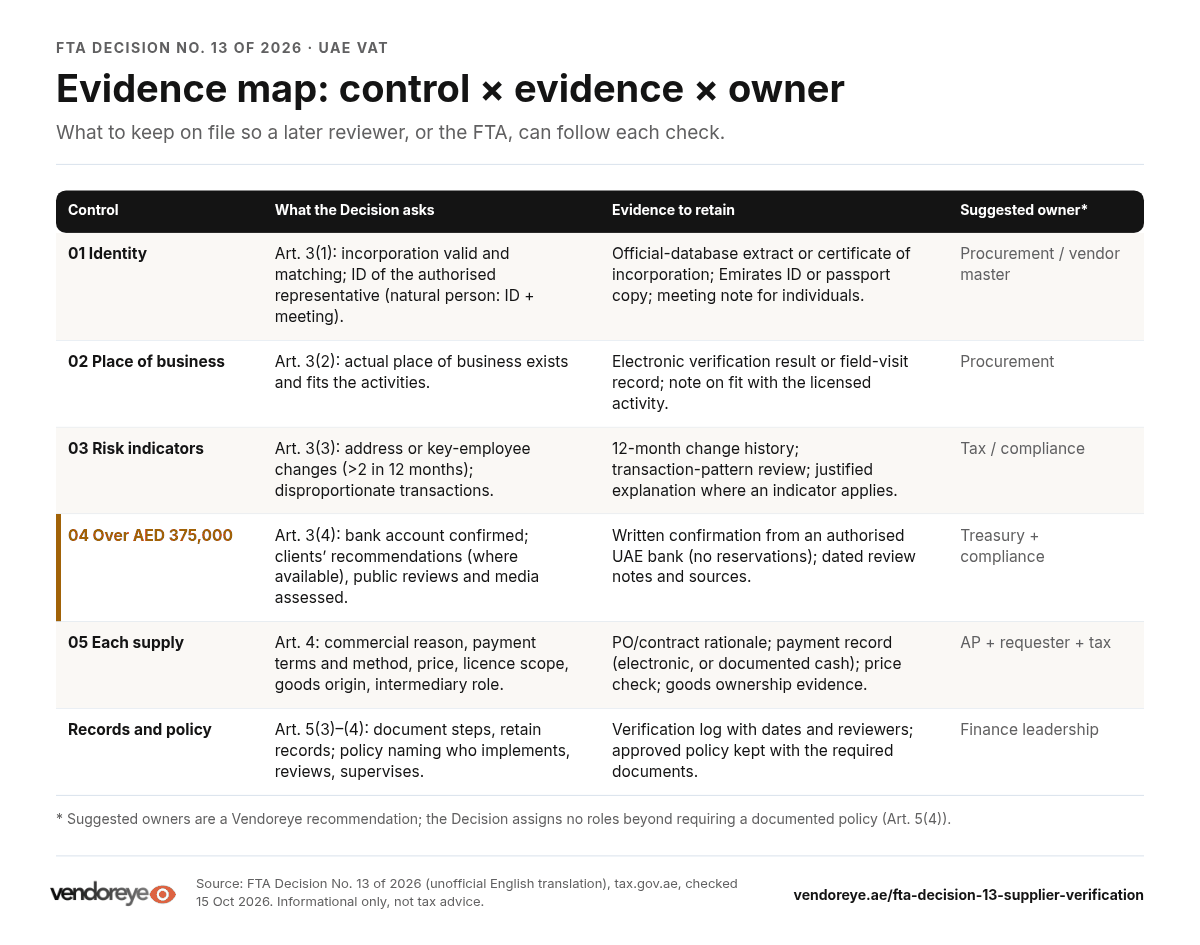
| Control | What the Decision asks | Evidence to retain | Suggested owner* |
|---|---|---|---|
| 01 Identity | Art. 3(1): incorporation valid and matching; ID of the authorised representative (natural person: ID and a meeting) | Official-database extract or certificate of incorporation; Emirates ID or passport copy; meeting note for individuals | Procurement / vendor master |
| 02 Place of business | Art. 3(2): an actual place of business that fits the activities | Electronic verification result or field-visit record; note on fit with the licensed activity | Procurement |
| 03 Risk indicators | Art. 3(3): address or key-employee changes (more than twice in 12 months); disproportionate transactions | 12-month change history; transaction-pattern review; justified explanation where an indicator applies | Tax / compliance |
| 04 Over AED 375,000 | Art. 3(4): bank account confirmed; clients' recommendations (where available), public reviews and media assessed | Written confirmation from an authorised UAE bank (no reservations); dated notes on recommendations, reviews and media, with sources | Treasury and compliance |
| 05 Each supply | Art. 4: commercial reason, payment terms and method, price, licence scope, goods origin, intermediary role | PO or contract rationale; payment record (electronic, or documented cash); price check; goods ownership evidence | AP, requester and tax |
| Records and policy | Art. 5(3)-(4): document steps and retain records; policy naming who implements, reviews and supervises | Verification log with dates and reviewers; approved policy kept with the required documents | Finance leadership |
*Suggested owners are Vendoreye's recommendation. The Decision does not assign roles beyond requiring a documented policy.
Keep personal data proportionate. Store an ID copy once, against the right entity, and reference it rather than re-attaching it to every invoice. Many teams also check the supplier's TRN with the FTA's TRN verification tool on tax.gov.ae. Decision 13 does not name that check, but it helps tie each invoice to the verified entity. See also UAE VAT registration checks and UAE VAT supplier checks before input tax.
Records and the documented policy (Article 5)
- Document the verification steps, and retain the supporting documents and records so the FTA can verify they were carried out correctly (Article 5(3)).
- Maintain a documented policy that identifies who implements, reviews and supervises the verification procedures, with their powers and responsibilities. Keep it at the designated location for the required documents (Article 5(4)).
Our vendor onboarding policy framework and the editable vendor onboarding policy template give you a starting structure. Add the Decision 13 roles to it.
Annual re-verification
Article 5(1) requires you to verify the supplier under Article 3:
- when dealing with the supplier for the first time, and
- on recurrent dealings where the supplier has not been verified over the previous 12 months.
The 12 months run separately for each supplier; there is no single calendar date. A practical set-up:
- Store a "last verified" date on each supplier record.
- Before booking input tax on a new supply, check that the date falls within the last 12 months. If it doesn't, re-run the Article 3 checks.
- Re-test the AED 375,000 and AED 100,000 totals on a rolling 12-month basis, looking backwards and forwards ("expected to exceed").
- Re-open a record early when facts change, such as a new address, new key contacts or new bank details. The risk indicators count changes over 12 months.
The per-supply checks (Article 4) are not annual. They apply to every supply.
How it interacts with UAE e-invoicing
Decision 13 and UAE e-invoicing are separate regimes under different instruments. The text of Decision 13 does not mention e-invoicing.
| FTA Decision No. 13 of 2026 | UAE Electronic Invoicing System | |
|---|---|---|
| Purpose | Verify the supplier and the supply before deducting input tax | Issue, exchange and report invoices as structured data |
| Issued by | Federal Tax Authority | Ministry of Finance (Ministerial Decisions No. 243 and 244 of 2025, as amended) |
| Start | In force 1 Oct 2026 | Pilot and voluntary use from 1 Jul 2026 (MD 244/2025, Arts. 3-4) |
| Mandatory phases | Not applicable | Revenue ≥ AED 50m: appoint an Accredited Service Provider by 30 Oct 2026 (MD 66/2026) and implement by 1 Jan 2027. Revenue < AED 50m: appoint by 31 Mar 2027, implement by 1 Jul 2027. Government entities: appoint by 31 Mar 2027, implement by 1 Oct 2027 (MD 244/2025, Art. 5) |
| Format | Any evidence that shows the checks were done | Structured eInvoice (PINT AE) exchanged through Accredited Service Providers. MoF: "pdf, word document, images, scanned copies and emails are not eInvoices" |
Source: MoF eInvoicing page and the decisions linked from it, checked 15 Oct 2026. Business-to-consumer transactions stay outside e-invoicing until a further ministerial decision (MD 244/2025, Art. 5(2)).
Where they meet (our view, not a legal requirement): both depend on clean supplier master data, meaning the legal name, registration details, TRN and address of one verified entity. A supplier record verified for Decision 13 can feed the identifiers your e-invoicing set-up needs. Nothing in Decision 13 says that receiving a valid eInvoice satisfies its checks. Read more: why a PDF is not a UAE e-invoice and the UAE e-invoicing timeline for vendor teams.
Checklist
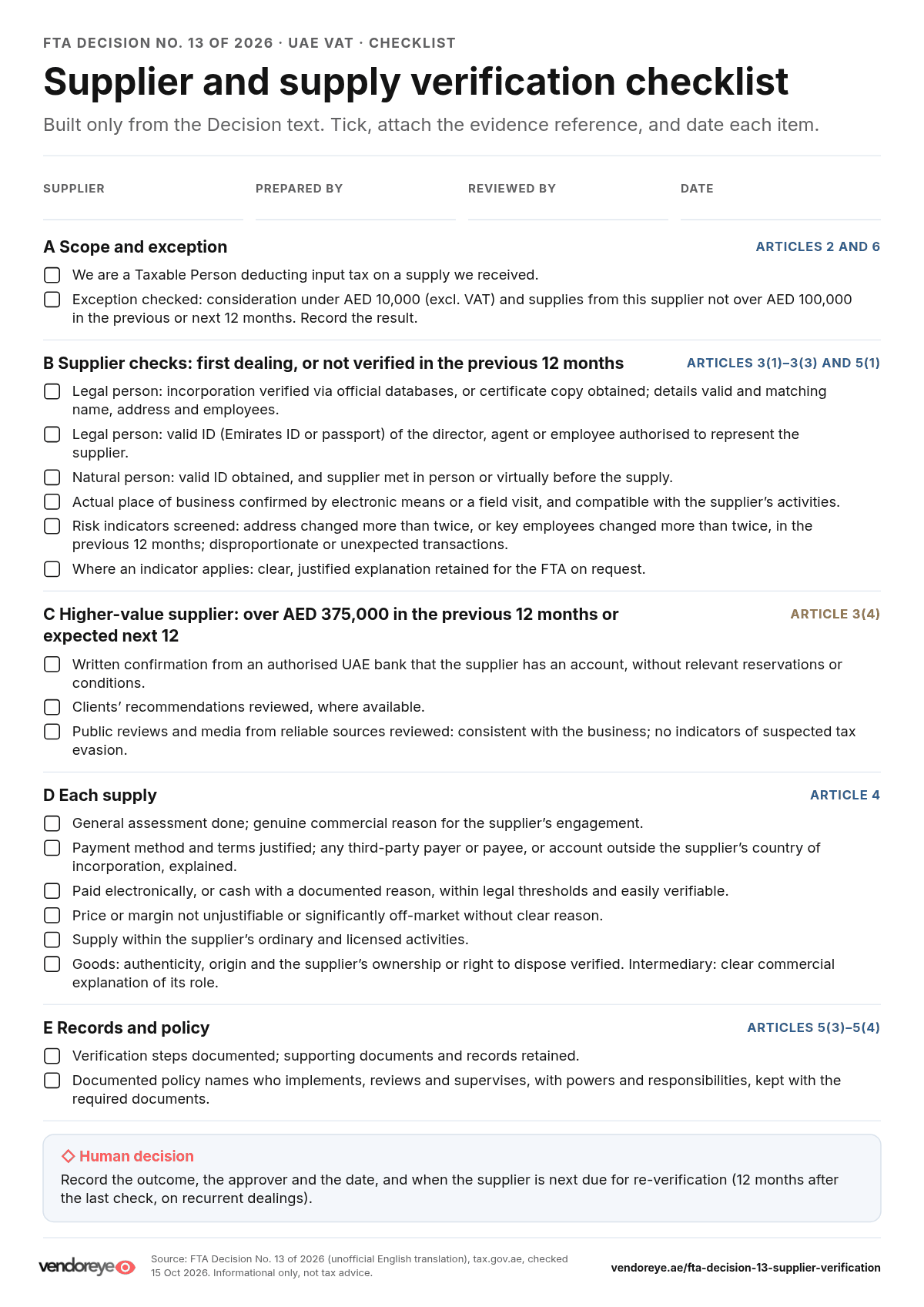
The one-page Decision 13 supplier and supply verification checklist is built only from the Decision's text. It covers:
- scope and exception;
- supplier checks;
- higher-value checks;
- each-supply checks;
- records and policy.
It ends with a ◇ human sign-off. The checklist is free: download the A4 PDF.
For how to complete it as preparer and approver, see how to complete the FTA Decision 13 checklist.
Where Vendoreye fits
Vendoreye's vendor verification workflow brings identity, UAE licence, VAT and bank-account checks into one governed workflow with continuous monitoring. The evidence, source, date and reviewer all sit on one supplier record. Automated checks produce signals; a named person decides. Vendoreye does not give tax advice and does not decide whether input tax is recoverable.
FAQs
When did FTA Decision 13 take effect?
On 1 October 2026 (Article 7). The tax.gov.ae text gives the issue date as 22 July 2026.
Do we need to verify suppliers for small purchases?
Not for a supply under AED 10,000 excluding VAT, unless supplies from that supplier exceed AED 100,000 over the previous 12 months or are expected to over the next 12 (Article 6).
How often must a supplier be re-verified?
On first dealing, and again on recurrent dealings once the supplier has not been verified for 12 months (Article 5(1)). Each supply is checked every time (Article 4).
What happens if a risk indicator applies?
Keep a clear, justified explanation and give it to the FTA on request. It must not contradict the evidence you hold (Article 3(3)(b)). The Decision does not say that an indicator alone blocks the deduction.
Does the bank confirmation have to be addressed to us?
No. It must come from an authorised bank in the UAE, confirm that the supplier has an account, and carry no relevant reservations or conditions. It does not need to be issued to the recipient of the supply (Article 3(4)(a)).
What is the risk to an input tax deduction in the UAE if we don't verify?
Under VAT Law Article 54(bis), a Taxable Person that did not verify its supplies under the FTA's measures is treated as having been required to know of any link to tax evasion. The FTA may then reject the input-tax deduction if the supply was part of such a chain.
Is the English text official?
No. The English PDF on tax.gov.ae states "This is not an official translation". The Arabic version is published on the FTA's Arabic page.
Does e-invoicing replace these checks?
No. They are separate regimes, and Decision 13 does not refer to e-invoicing.
References and further reading (official sources, checked 15 Oct 2026)
- FTA Decision No. 13 of 2026 (FTA page)
- FTA Decision No. 13 of 2026, English PDF (unofficial translation)
- FTA Decision No. 13 of 2026, Arabic page
- Federal Decree-Law No. 8 of 2017 on VAT and its amendments (consolidated, incl. Article 54(bis))
- FTA: Amendments to the VAT Decree-Law (Federal Decree-Laws No. 16 of 2024 and No. 16 of 2025)
- MoF: VAT law amendments from January 2026 (3 Dec 2025)
- MoF eInvoicing programme
- Ministerial Decision No. 244 of 2025 on the implementation of the Electronic Invoicing System
- Ministerial Decision No. 66 of 2026 amending MD 244/2025
Related resources
- FTA Decision 13: 90-day implementation plan
- FTA Decision 13 checklist (free A4 template)
- How to complete the FTA Decision 13 checklist
- Vendor verification and continuous monitoring
- UAE VAT verification · UAE trade licence verification · IBAN verification
- Vendor onboarding policy template and the resource library
Change log
- 19 October 2026: first published. Official sources checked 15 October 2026. The tax.gov.ae Decision 13 page was last updated 20 August 2026.